Posted 3 hours ago
Cruise in the Mediterranean from Barcelona to Civitavecchia aboard Queen Elizabeth ship with visits to Spain, France, Italy, Malta, Montenegro, Croatia, and Greece for 22 days
About this cruise
Embark on a 22-day cruise in the Mediterranean, departing from Barcelona and ending in Civitavecchia on the Queen Elizabeth ship. Explore enchanting destinations in Spain, France, Italy, Malta, Montenegro, Croatia, and Greece during your journey.
Day : Valencia, Spain. Located on the east coast of Spain, Valencia was founded by the Romans and later occupied by the Moors in the early Middle Ages before being reconquered by the Christians. The old town features many remarkable buildings such as the Cathedral, dating back to 1262, with its bell tower serving as Valencia`s symbol, as well as the Church of Saint Catherine. Visitors can explore the two well-preserved towers of the medieval city wall. For relaxation, taking a ride on the modern tram to one of Valencia`s many beaches is a great option.
Sights: Cathedral, Basilica of Virgen de los Desamparados, Imperial Monastery, Church of San Nicolas, Church of San Martin, La Lonja de la Seda, Town Hall, Central Market, Colon Market, North Station, Turia Gardens, City of Arts and Sciences.
Day : Palma (Mallorca), Balearic Islands. The port of Palma de Mallorca can accommodate eight cruise ships simultaneously. These can dock at the northwest or southwest docks as well as the West Pier. The city center is located about 6 to 7 km from the West Pier and about 5 km from the northwest or southwest docks. A shuttle service is available at around €9 per person, but buses also provide access to the capital of the Balearic Islands. Palma de Mallorca serves as an economic and cultural center of Mallorca. In the 13th and 14th centuries, the city evolved into a major trading hub in the western Mediterranean. Trade brought the city wealth and prestige. Most of the major historical buildings in Mallorca date back to that time. In Palma, life thrives both on the shaded boulevard Passeig des Born and in the narrow streets of the historic district. Palma, as a modern metropolis, still boasts an attractive city center with notable attractions such as the Cathedral `La Seu` with its Gothic spires, the `Almudaina` Palace, the former residence of the Mallorcan royal family, and the commercial exchange building `La Llotja`. The `Mercat Olivar` market hall, frequented by locals, is also found here.
Day : Sea day.
Day : Ajaccio (Corsica), France. The capital of the French island of Corsica and the "Département Corse-du-Sud" is surrounded by beautiful mountain landscapes, valleys, and villages that invite walks and excursions in the surroundings. The city, with 59,300 inhabitants, is not only a popular winter resort but also known as the birthplace of Napoleon I, who was born on August 15, 1769 in a house on Rue Saint Charles. Today, numerous streets, statues, and monuments still remind of the famous son of the city. In the city hall, some impressive exhibits testify to the coronation of the former emperor. Attractions of the port city include the church of Saint-Erasme, dedicated to the patron saint of sailors and decorated with ship models, where Napoleon was baptized in 1539. The Fesch Museum offers a collection of works by Boticelli, Bellini, and Titian - donations from Cardinal Fesch, Napoleon`s uncle. Sports activities in Ajaccio are mainly offered in connection with the sea: year-round diving, jet skiing, sailing, fun boarding, and deep-sea fishing.
Day : La Spezia, Italy. The city of La Spezia, with its approximately 110,000 inhabitants, is located on the lush hills of Italy. This port city borders the steep cliffs of "Cinque Terre" to the north and boasts beautiful beaches near "Carrara" in the south. La Spezia is known as a modern port and industrial city, with the added charm of Art Nouveau architecture. Palm trees and oleanders characterize the cityscape. It is influenced by both tourism and the naval base located there.
Sights: Large Friday market on "Viale Garibaldi", Shipbuilding Museum "Museo Navale", "Castello San Giorgio".
Day : Sea day.
Day : Civitavecchia (Rome), Italy. The Italian capital city of Rome is also known as "the Eternal City" because the vibrant metropolis still houses valuable and world-famous treasures from antiquity. Some of the city`s key attractions include the "Baths of Caracalla", the imperial forum, the Colosseum, the "Piazza Navona", the Fountain of Neptune, and of course, St. Peter`s Basilica with Michelangelo`s dome.
Day : Sea day.
Day : Valletta, Malta. Valletta is the first city of modern times, entirely designed by Jean de la Valetta of the Knights of St. John. The capital of Malta is a UNESCO World Heritage Site. Upon entering the harbor, you can see the impressive fortifications of the old town with its grand buildings. The city invites visitors to explore the solemn St. John`s Co-Cathedral and the Grandmaster`s Palace of the Knights of St. John from the 16th century. The bustling Republic Street is a testament to socializing and shopping fun. Other attractions include the Upper Barrakka Gardens, the National Archaeology Museum, Fort St. Elmo with its military museum, and the historic palace.
Day : Sea day.
Day : Kotor, Montenegro. Kotor is a picturesque town located in the bay of the same name, founded by Greek colonists and now belonging to the Republic of Montenegro. Despite the severe earthquake in 1979, all the old buildings were preserved. Among them are the main attractions: the Romanesque Cathedral of "Sv. Tripun" from the 12th century with its magnificent interior, the church of "Sv. Luka" built in the Greek-Byzantine style, a clock tower from the 17th century, and the fortress of "St. Ivan" with a triple defensive wall. The Maritime Museum is also worth a visit.
The Bay of Kotor, "Boka Kotorska", is one of the most beautiful landscapes in Europe. It is shaped like a fjord, deeply cutting into the land and surrounded by high mountains. Several small coves invite visitors to swim. The asymmetrical view of narrow streets and squares showcases numerous valuable medieval architectural monuments, contributing to Kotor being designated a UNESCO World Heritage site.
Day : Split, Croatia. The old town of the Mediterranean port of Split on the eastern Adriatic coast in Dalmatia has been a UNESCO World Heritage Site since 1979. The heart of Croatia`s second-largest city beats within the walls of the 1,500-year-old Diocletian`s Palace. Split reveals its best side to visitors even before they enter the harbor: the palm-lined waterfront promenade in front of the imperial palace and the rooftops of the old town provide a unique panorama.
Sights: medieval old town, Diocletian`s Palace, Riva waterfront promenade, Archaeological Museum, City Art Gallery, Golden Gate, Cathedral, Old Town Hall.
Day : Zadar, Croatia. In southern Croatia, in Northern Dalmatia, lies a pearl of Croatian culture and history: the port city of Zadar. This seaside resort on the Adriatic Sea boasts numerous attractions, such as a forum, a basilica, a temple, and an amphitheater outside the city. Also, visit the Archaeological Museum and explore valuable artifacts from Roman times.
Day : Trieste, Italy. Trieste, with its two-thousand-year-old port, is situated in a picturesque setting surrounded by sea and hills on the northern Adriatic coast. Narrow streets line the old town. The Piazza Unità d`Italia, the city center and traditional meeting point for the residents of Trieste, features impressive neoclassical buildings; while the ancient monuments of the city lie at the Colle di San Giusto. At the foot of this hill, visitors can admire the baroque church of Santa Maria Maggiore. The main symbol of the port city is the Cathedral of San Giusto, and the waterfront promenades are also inviting for leisurely walks. Points of interest include: Duino Castle, Giant Cave, remnants of the city walls and the Roman city center, Maritime Aquarium, Victory Lighthouse, and the Old Stock Exchange building.
Day : Sea day.
Day : Dubrovnik, Croatia. The Croatian port city of Dubrovnik is known as a prominent resort town. It was founded by Slavs around the beginning of the 7th century. Nowadays, the city on the Adriatic coast is renowned for its excellent shopping opportunities, numerous shops, and cultural institutions. The main street of the old town is the "Stradun" (also known as "Placa"). From this street, all the city`s major attractions can be easily reached on foot. The entire old town has been on the UNESCO World Heritage List since 1980. Notable sights include: the 13th-century city walls, the Franciscan monastery with its monastery pharmacy, the Rector`s Palace from the 15th century, the "Sponza Palace," the Ethnographic Museum, the Cathedral, and the "Church of St. Blaise.".
Day : Corfu (Corfu), Greece. Kerkyra is the capital of the Greek island of Corfu, located on the east coast. The main attraction of the island is the ancient Artemis Temple, of which only a few remains are left. The Old Town of Kerkyra is also worth a visit, designated as a UNESCO World Heritage site in 2007. Strolling through its streets, visitors can admire ancient buildings from the medieval period. The charming narrow alleyways are a particularly beautiful sight. A visit to one of the traditional tavernas offers the opportunity to savor freshly caught fish.
Day : Kefalonia, Greece. Kefalonia is not only the largest and northernmost of the Ionian Islands, but also the most diverse. There are dense dark fir forests on the slopes of the highest mountain, Mount Ainos (1628m), as well as steppe-like plateaus or gentle olive groves with cypress trees. There are various caves and some remarkable geological phenomena. Culturally, the island has several monasteries to offer. The island`s area is 781 km2, making it the sixth largest Greek island. Kefalonia is made up of four peninsulas (Paliki, Erissos, Livatho, and Omalon), with Ithaca located to the northeast.
Day : Strait of Messina, Italy. The legendary strait of the Mediterranean, which separates Sicily and Italy, connects the Ionian and Tyrrhenian Seas. Famous for its fountains, Messina is one of the liveliest places in the summer. The charming city invites visitors to explore the cathedral with its bell tower and discover the world`s largest astronomical clock. The port of Messina is particularly worth seeing.
Day : Naples, Italy. The city has Greek origins and belonged to the Sicilian Kingdom of the Normans in the 11th century. From 1282 until the founding of Italy in 1861, it was the capital of the Kingdom of Naples. Worth seeing are the Piazza Garibaldi (the main square of Naples in front of the central train station with the Garibaldi monument, Via Umberto I with many shops, fruit and fish markets, and street vendors everywhere); the old town districts (with the port, the city gate Porta Capuana, the Church of San Francesco, the town hall, and the Galleria Umberto I); the former Royal Palace Palazzo Reale (with the National Library); Castel Sant`Elmo (from the 14th century, located on a hill above the city); the Cathedral of San Gennaro (from the 13th century, with the tomb of the patron saint of Naples, St. Januarius); the National Archaeological Museum (with the famous Alexander Mosaic); and the National Museum (with many findings from Herculaneum and Pompeii).
Day : Civitavecchia (Rome), Italy. The Italian capital city of Rome is also known as "the Eternal City" because the vibrant metropolis still houses valuable and world-famous treasures from antiquity. Some of the city`s key attractions include the "Baths of Caracalla", the imperial forum, the Colosseum, the "Piazza Navona", the Fountain of Neptune, and of course, St. Peter`s Basilica with Michelangelo`s dome.
Cabin Prices
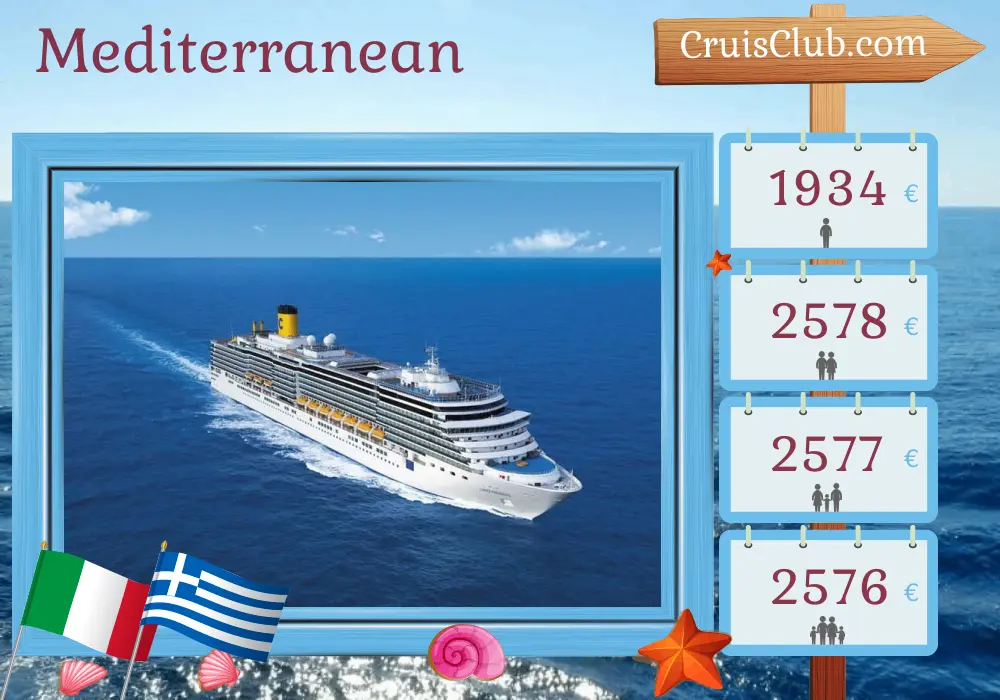
The cruise price at the top of the page (3.690€) is listed for the accommodation of one person in a double cabin. To get the total cabin cost, multiply this price by two. All subsequent prices are listed for the entire cabin and do not require additional multiplication.
All prices presented on this website are approximate and do not constitute a public offer. For precise price information, please contact the service provider.
Single Cabin Price
| Cruise Date | Interior Cabin | Ocean View Cabin | Balcony Cabin | Suite |
| 11/06/2027 - 02/07/2027 | 7.380€ | 7.980€ | 9.380€ | 16.980€ |
Double Cabin Price
| Cruise Date | Interior Cabin | Ocean View Cabin | Balcony Cabin | Suite |
| 11/06/2027 - 02/07/2027 | 7.380€ | 7.980€ | 9.380€ | 16.980€ |
Cabin Price for Two Adults with One Child
| Cruise Date | Interior Cabin | Ocean View Cabin | Balcony Cabin | Suite |
| 11/06/2027 - 02/07/2027 | 9.730€ | - | 12.480€ | 21.230€ |
Cabin Price for Two Adults with Two Children
| Cruise Date | Interior Cabin | Ocean View Cabin | Balcony Cabin | Suite |
| 11/06/2027 - 02/07/2027 | 11.670€ | - | - | - |
Cruise Route
Day : Barcelona, Spain. The city is a successful blend of tradition and modernity. Here you can find both historic buildings from the Middle Ages and modern architecture. Barcelona is considered the most important economic center of Catalonia. In terms of culture, the Mediterranean metropolis has a lot to offer, including the Picasso Museum, the Museum of Modern Art, and the National Art Museum of Catalonia. In the Gothic old town "Barri Gotic" stands the Cathedral "La Seu" from the 13th century. But the iconic symbol of Barcelona is the church "Sagrada Familia", designed by Antonio Gaudí. In Barcelona, there is a bustling business scene during the day as well as an active nightlife. Another sight to see is the "Rambles", the magnificent promenade located in the center with numerous street cafes, shops, restaurants, bars, and nightclubs. Additionally, one should not miss "El Puerto", the port with a beautiful view over Barcelona and the nearby Boulevard "Paseo de Colón".Day : Valencia, Spain. Located on the east coast of Spain, Valencia was founded by the Romans and later occupied by the Moors in the early Middle Ages before being reconquered by the Christians. The old town features many remarkable buildings such as the Cathedral, dating back to 1262, with its bell tower serving as Valencia`s symbol, as well as the Church of Saint Catherine. Visitors can explore the two well-preserved towers of the medieval city wall. For relaxation, taking a ride on the modern tram to one of Valencia`s many beaches is a great option.
Sights: Cathedral, Basilica of Virgen de los Desamparados, Imperial Monastery, Church of San Nicolas, Church of San Martin, La Lonja de la Seda, Town Hall, Central Market, Colon Market, North Station, Turia Gardens, City of Arts and Sciences.
Day : Palma (Mallorca), Balearic Islands. The port of Palma de Mallorca can accommodate eight cruise ships simultaneously. These can dock at the northwest or southwest docks as well as the West Pier. The city center is located about 6 to 7 km from the West Pier and about 5 km from the northwest or southwest docks. A shuttle service is available at around €9 per person, but buses also provide access to the capital of the Balearic Islands. Palma de Mallorca serves as an economic and cultural center of Mallorca. In the 13th and 14th centuries, the city evolved into a major trading hub in the western Mediterranean. Trade brought the city wealth and prestige. Most of the major historical buildings in Mallorca date back to that time. In Palma, life thrives both on the shaded boulevard Passeig des Born and in the narrow streets of the historic district. Palma, as a modern metropolis, still boasts an attractive city center with notable attractions such as the Cathedral `La Seu` with its Gothic spires, the `Almudaina` Palace, the former residence of the Mallorcan royal family, and the commercial exchange building `La Llotja`. The `Mercat Olivar` market hall, frequented by locals, is also found here.
Day : Sea day.
Day : Ajaccio (Corsica), France. The capital of the French island of Corsica and the "Département Corse-du-Sud" is surrounded by beautiful mountain landscapes, valleys, and villages that invite walks and excursions in the surroundings. The city, with 59,300 inhabitants, is not only a popular winter resort but also known as the birthplace of Napoleon I, who was born on August 15, 1769 in a house on Rue Saint Charles. Today, numerous streets, statues, and monuments still remind of the famous son of the city. In the city hall, some impressive exhibits testify to the coronation of the former emperor. Attractions of the port city include the church of Saint-Erasme, dedicated to the patron saint of sailors and decorated with ship models, where Napoleon was baptized in 1539. The Fesch Museum offers a collection of works by Boticelli, Bellini, and Titian - donations from Cardinal Fesch, Napoleon`s uncle. Sports activities in Ajaccio are mainly offered in connection with the sea: year-round diving, jet skiing, sailing, fun boarding, and deep-sea fishing.
Day : La Spezia, Italy. The city of La Spezia, with its approximately 110,000 inhabitants, is located on the lush hills of Italy. This port city borders the steep cliffs of "Cinque Terre" to the north and boasts beautiful beaches near "Carrara" in the south. La Spezia is known as a modern port and industrial city, with the added charm of Art Nouveau architecture. Palm trees and oleanders characterize the cityscape. It is influenced by both tourism and the naval base located there.
Sights: Large Friday market on "Viale Garibaldi", Shipbuilding Museum "Museo Navale", "Castello San Giorgio".
Day : Sea day.
Day : Civitavecchia (Rome), Italy. The Italian capital city of Rome is also known as "the Eternal City" because the vibrant metropolis still houses valuable and world-famous treasures from antiquity. Some of the city`s key attractions include the "Baths of Caracalla", the imperial forum, the Colosseum, the "Piazza Navona", the Fountain of Neptune, and of course, St. Peter`s Basilica with Michelangelo`s dome.
Day : Sea day.
Day : Valletta, Malta. Valletta is the first city of modern times, entirely designed by Jean de la Valetta of the Knights of St. John. The capital of Malta is a UNESCO World Heritage Site. Upon entering the harbor, you can see the impressive fortifications of the old town with its grand buildings. The city invites visitors to explore the solemn St. John`s Co-Cathedral and the Grandmaster`s Palace of the Knights of St. John from the 16th century. The bustling Republic Street is a testament to socializing and shopping fun. Other attractions include the Upper Barrakka Gardens, the National Archaeology Museum, Fort St. Elmo with its military museum, and the historic palace.
Day : Sea day.
Day : Kotor, Montenegro. Kotor is a picturesque town located in the bay of the same name, founded by Greek colonists and now belonging to the Republic of Montenegro. Despite the severe earthquake in 1979, all the old buildings were preserved. Among them are the main attractions: the Romanesque Cathedral of "Sv. Tripun" from the 12th century with its magnificent interior, the church of "Sv. Luka" built in the Greek-Byzantine style, a clock tower from the 17th century, and the fortress of "St. Ivan" with a triple defensive wall. The Maritime Museum is also worth a visit.
The Bay of Kotor, "Boka Kotorska", is one of the most beautiful landscapes in Europe. It is shaped like a fjord, deeply cutting into the land and surrounded by high mountains. Several small coves invite visitors to swim. The asymmetrical view of narrow streets and squares showcases numerous valuable medieval architectural monuments, contributing to Kotor being designated a UNESCO World Heritage site.
Day : Split, Croatia. The old town of the Mediterranean port of Split on the eastern Adriatic coast in Dalmatia has been a UNESCO World Heritage Site since 1979. The heart of Croatia`s second-largest city beats within the walls of the 1,500-year-old Diocletian`s Palace. Split reveals its best side to visitors even before they enter the harbor: the palm-lined waterfront promenade in front of the imperial palace and the rooftops of the old town provide a unique panorama.
Sights: medieval old town, Diocletian`s Palace, Riva waterfront promenade, Archaeological Museum, City Art Gallery, Golden Gate, Cathedral, Old Town Hall.
Day : Zadar, Croatia. In southern Croatia, in Northern Dalmatia, lies a pearl of Croatian culture and history: the port city of Zadar. This seaside resort on the Adriatic Sea boasts numerous attractions, such as a forum, a basilica, a temple, and an amphitheater outside the city. Also, visit the Archaeological Museum and explore valuable artifacts from Roman times.
Day : Trieste, Italy. Trieste, with its two-thousand-year-old port, is situated in a picturesque setting surrounded by sea and hills on the northern Adriatic coast. Narrow streets line the old town. The Piazza Unità d`Italia, the city center and traditional meeting point for the residents of Trieste, features impressive neoclassical buildings; while the ancient monuments of the city lie at the Colle di San Giusto. At the foot of this hill, visitors can admire the baroque church of Santa Maria Maggiore. The main symbol of the port city is the Cathedral of San Giusto, and the waterfront promenades are also inviting for leisurely walks. Points of interest include: Duino Castle, Giant Cave, remnants of the city walls and the Roman city center, Maritime Aquarium, Victory Lighthouse, and the Old Stock Exchange building.
Day : Sea day.
Day : Dubrovnik, Croatia. The Croatian port city of Dubrovnik is known as a prominent resort town. It was founded by Slavs around the beginning of the 7th century. Nowadays, the city on the Adriatic coast is renowned for its excellent shopping opportunities, numerous shops, and cultural institutions. The main street of the old town is the "Stradun" (also known as "Placa"). From this street, all the city`s major attractions can be easily reached on foot. The entire old town has been on the UNESCO World Heritage List since 1980. Notable sights include: the 13th-century city walls, the Franciscan monastery with its monastery pharmacy, the Rector`s Palace from the 15th century, the "Sponza Palace," the Ethnographic Museum, the Cathedral, and the "Church of St. Blaise.".
Day : Corfu (Corfu), Greece. Kerkyra is the capital of the Greek island of Corfu, located on the east coast. The main attraction of the island is the ancient Artemis Temple, of which only a few remains are left. The Old Town of Kerkyra is also worth a visit, designated as a UNESCO World Heritage site in 2007. Strolling through its streets, visitors can admire ancient buildings from the medieval period. The charming narrow alleyways are a particularly beautiful sight. A visit to one of the traditional tavernas offers the opportunity to savor freshly caught fish.
Day : Kefalonia, Greece. Kefalonia is not only the largest and northernmost of the Ionian Islands, but also the most diverse. There are dense dark fir forests on the slopes of the highest mountain, Mount Ainos (1628m), as well as steppe-like plateaus or gentle olive groves with cypress trees. There are various caves and some remarkable geological phenomena. Culturally, the island has several monasteries to offer. The island`s area is 781 km2, making it the sixth largest Greek island. Kefalonia is made up of four peninsulas (Paliki, Erissos, Livatho, and Omalon), with Ithaca located to the northeast.
Day : Strait of Messina, Italy. The legendary strait of the Mediterranean, which separates Sicily and Italy, connects the Ionian and Tyrrhenian Seas. Famous for its fountains, Messina is one of the liveliest places in the summer. The charming city invites visitors to explore the cathedral with its bell tower and discover the world`s largest astronomical clock. The port of Messina is particularly worth seeing.
Day : Naples, Italy. The city has Greek origins and belonged to the Sicilian Kingdom of the Normans in the 11th century. From 1282 until the founding of Italy in 1861, it was the capital of the Kingdom of Naples. Worth seeing are the Piazza Garibaldi (the main square of Naples in front of the central train station with the Garibaldi monument, Via Umberto I with many shops, fruit and fish markets, and street vendors everywhere); the old town districts (with the port, the city gate Porta Capuana, the Church of San Francesco, the town hall, and the Galleria Umberto I); the former Royal Palace Palazzo Reale (with the National Library); Castel Sant`Elmo (from the 14th century, located on a hill above the city); the Cathedral of San Gennaro (from the 13th century, with the tomb of the patron saint of Naples, St. Januarius); the National Archaeological Museum (with the famous Alexander Mosaic); and the National Museum (with many findings from Herculaneum and Pompeii).
Day : Civitavecchia (Rome), Italy. The Italian capital city of Rome is also known as "the Eternal City" because the vibrant metropolis still houses valuable and world-famous treasures from antiquity. Some of the city`s key attractions include the "Baths of Caracalla", the imperial forum, the Colosseum, the "Piazza Navona", the Fountain of Neptune, and of course, St. Peter`s Basilica with Michelangelo`s dome.